


What is a floating labyrinth oil seal?
some of floating motor labyrinth oil seal is in stock ,If you need floating motor labyrinth oil seal,please send mail to [email protected]
What is a floating labyrinth oil seal?
A floating labyrinth oil seal is a type of oil seal that combines “floating” and “labyrinth” sealing mechanisms.Primarily used for the shaft-bearing seals
of high-voltage motors, it employs a split-type design and labyrinth grooves to effectively contain lubricating oil and facilitate its return.
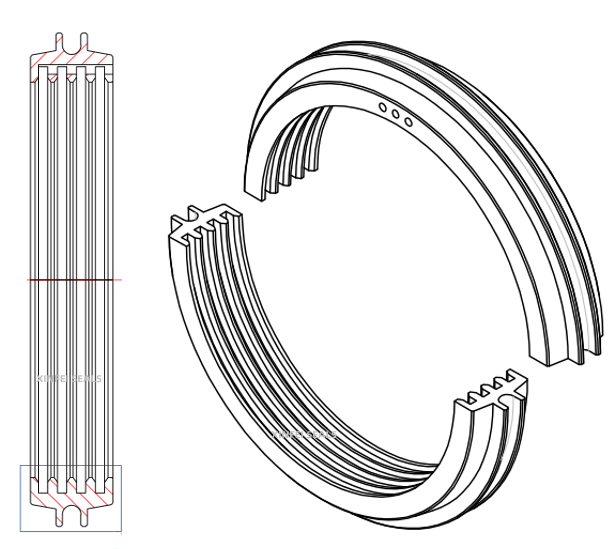
1.The polyimide labyrinth floating seal ring is a two-half ring structure, which is composed of an oil return hole, a positioning pin and a spring groove.
2.The labyrinth floating seal ring has four grooves in the inner ring and one groove in the outer ring for snap springs.
3.The labyrinth floating seal ring positioning pin contain three round holes, and three round holes in the opposite position, and the left round hole
is the oil return groove.
What is the operating principle of a floating labyrinth oil seal?
1.Labyrinth-based flow restriction
The inner side of the oil seal features a series of continuous annular grooves, which create a tortuous, labyrinth-like flow path. As lubricating oil attempts to leak outward, it undergoes a repeated process of “throttling/pressure reduction” followed by “cavity expansion” at each groove: As the oil passes through a narrow gap, its flow velocity surges and its pressure drops. Upon entering the cavity of a groove, the volume expands suddenly;kinetic energy is converted into thermal energy, and the pressure is unable to recover. After passing through multiple grooves, the oil pressure is dissipated stage by stage. This significantly increases resistance to leakage, effectively eliminating the driving force behind outward seepage.
2.Floating dynamic compensation
The oil seal utilizes a split, semi-ring structure combined with elastic elements (such as springs or O-rings) to allow for radial floating:
If the motor shaft experiences eccentricity, vibration, or axial movement, the sealing ring can automatically slide radially within its groove, compensating for shaft misalignments of up to ±1.5°. As the sealing surfaces wear down, the elastic elements release stored energy, continuously exerting axial pressure to automatically compensate for the wear and ensure the surfaces remain in close contact over the long term.
3.Self-sealing via an oil film
Driven by capillary suction, centrifugal force generated by the rotating shaft, and internal pressure resulting from temperature rises within the sealing chamber, lubricating oil is precisely directed into the sealing gap:
A uniform oil film—only microns thick—forms between the two precision surfaces sliding against each other. This creates a liquid barrier that completely blocks the leakage path, while simultaneously lubricating and cooling the sealing surfaces to prevent overheating and damage caused by dry metal-on-metal friction. In conjunction with the oil-return holes provided on the oil seal, a small amount of oil that enters the labyrinth grooves can flow back through these channels into the bearing oil chamber, establishing a virtuous cycle of “sealing – returning – resealing.”
What products are floating labyrinth oil seals used for?
The labyrinth floating seal ring is suitable for various specifications of generator set equipment, desulfurization and off-sales equipment, various types of power station auxiliary machines and AC and DC motors.
Products are widely used in coal mining, smelting, petrochemical,power generation and other industries.
Main Applications:
Aerospace: Gas turbines, jet engines (sealing gases, preventing oil leaks, enhancing efficiency).
Power Generation: Steam turbines, generators, compressors (managing high pressure, sealing against water).
Automotive: Engines (crankshafts, camshafts), transmissions, turbochargers (oil/coolant retention, friction reduction).
Chemical Processing: Reactors, pumps (sealing corrosive or flammable media).
Marine: Propulsion systems (withstanding harsh conditions, corrosion).
Industrial Machinery: Pumps, compressors, electric motors (general contamination control, enhanced reliability).
Modes Of Transport

XINFEI INDUSTRY BEIJING CO., LTD
ADDRESS: YANGZHENG INDUSTRY DISTRICT, SHUNYI,BEIJING
EMAIL:[email protected]

Related products


oil seals
oil seals

oil seals
oil seals
oil seals
oil seals

oil seals
oil seals
